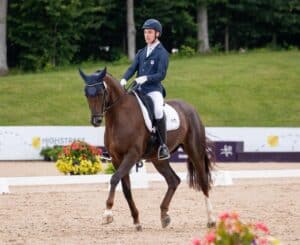


by Danielle Henson/US Equestrian Communications Dept.
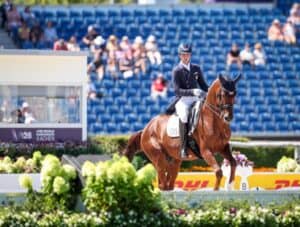
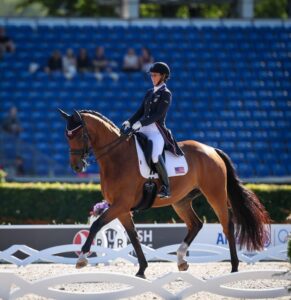
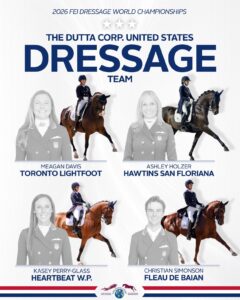
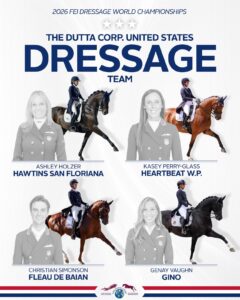
With the 2026 FEI Dressage World Championships less than three months away, US Equestrian has named its short list of horse-and-rider combinations vying for a spot on The Dutta Corp. U.S. Dressage Team heading to Aachen, Germany. Eight combinations representing a meld of seasoned championship veterans and exciting newcomers to the international stage have been selected to continue their pursuit of a team berth.
The Short List includes Meagan Davis (Loxahatchee, Florida) and Toronto Lightfoot, Ashley Holzer (Wellington, Florida) and Hawtins San Floriana, Jordan LaPlaca (Ledyard, Connecticut) and Gold Play, Anna Marek (Williston, Florida) and Fayvel, Kasey Perry-Glass (Wellington, Florida) and Heartbeat W.P., Christian Simonson (Ventura, California) and Fleau de Baian and Indian Rock, and Geñay Vaughn (Elk Grove, California) and Gino.
To better understand the process behind the selections and what lies ahead for these combinations on the road to Aachen, we sat down with U.S. Dressage Chef d’Equipe and Technical Advisor Christine Traurig for an exclusive conversation.
The short list for the 2026 FEI Dressage World Championship has been announced. Can you walk us through how those selections were made?
The selection of our short list was based upon the criteria outlined in our selection procedures, which established a ranking list going into the USEF Grand Prix Dressage National Championship. The USEF Grand Prix Dressage National Championship is a standalone event, and it served as the last observation event for riders who had applied for the 2026 FEI World Championships. The event was not a final selection trial. It was part of the selection procedures and therefore considered an observation event.
The factors taken into consideration included the riders’ rankings, the scores they achieved throughout the qualifying period, the consistency of those scores, and the trajectory of those scores over time. Following the conclusion of the Grand Prix National Championship, we met with the selectors to discuss all the combinations in contention. We put a recommendation forward, the selectors discussed everything thoroughly, made their decisions, and then went through the approval process.
Looking at the horse-and-rider combinations named to the short list, what stands out to you about this group?
I think we have named combinations who have fulfilled some very important criteria. The scores they achieved throughout the qualifying period, their rankings going into the USEF Grand Prix Dressage National Championship, and their standings after its conclusion. What I find particularly exciting is that we have some younger, fresher combinations on this Short List. For some of them, this is the first time being named to a Short List, and therefore the first time going to Europe to compete. That gives us the opportunity to further evaluate these combinations as we look toward ultimately naming the team for Aachen.
For those newer combinations especially, what do you hope they take away from the experience of competing in Europe this summer?
I think it is an extraordinarily important experience, at every level. Even for a seasoned rider who has competed for the United States abroad before, competing as part of a team carries a completely different weight of pressure. You are not only representing yourself, but you are also representing the team, the United States Equestrian Federation, and your country. That is a whole different level, and it is something I believe our younger, greener combinations need to experience firsthand.
Beyond that, competing in Europe means facing riders from many nations in an environment our athletes simply don’t encounter frequently on the North American continent. That exposure is invaluable and if they are fortunate enough to go on and make the team for Aachen, that will be the icing on the cake. That is where a rider truly feels what pressure means. There is no doubt they will have to learn to handle it, manage it, and channel it. I believe it is equally important for the horses — we must see that the horses have the mentality, as well as the physical and mental condition to perform in that environment.
Perhaps just as importantly, I want them to experience team camaraderie. Team building. Team support. I genuinely believe that is what will elevate both their performance and their confidence.
Throughout the observation process, how did you help athletes determine which Observation Events to compete in to best suit their horses?
Throughout the process, riders had the freedom to choose whatever CDIs they wanted to attend to accumulate their scores, which then established their position on the ranking list. Whether that was in Wellington, Del Mar, Ocala, or any other venue — whatever suited them and their horses best. Our qualifying period for the FEI World Championships began last September, so there was ample time for riders to plan and strategize thoughtfully.
That said, I was always available, together with the riders and their personal trainers, to discuss their plans. I received wonderful feedback from riders and their coaches throughout that process, which I found genuinely helpful.
Going forward, short-listed riders are now required to submit a competition plan when they head to Europe. They will outline where they plan to be based, confirm they have coordinated with their personal coaches, and address the various logistical elements involved. We will then sit down together — the rider, their coach, and myself — and discuss that plan. I will make recommendations based on what I have observed: the horse’s age, international experience, the rider’s experience competing in Europe, and ultimately, what this combination needs to arrive at Aachen in the best possible state of preparation.
What goes into ensuring these combinations are peaking at the right moment for a World Championship that falls mid-August?
What ensures that, above all, is having a good plan in place and making sure we have all the information we need to best support each combination — not only at competitions, but between them as well. We want the horses healthy, the riders confident, and the personal coaches fully aligned. Our veterinary staff will be available to support the well-being of the horses throughout.
I will be in Europe from mid-June onward, which allows me to visit the riders wherever they are based and observe them in training. After the team is named, we will hold a ten-day training camp for the team and the reserve combinations. That camp is about more than preparation. It is about building something. I want these riders to truly feel like a team, to feel the support of one another, to build the kind of trust and camaraderie that shows in the ring.
A few names that drew attention at the USEF Grand Prix Dressage National Championship didn’t appear on the short list — can you speak to that?
I think it’s worth addressing. Ellesse Gundersen won the National Championship with Quintessential 4, they were outstanding, but she is not on the Short List.
Gundersen did not apply to qualify for the FEI World Championship. I think that was an extremely smart and strategic decision. Her horse is still young, and she wants to develop him carefully and deliberately. She made the thoughtful judgment that a competition of this magnitude in Aachen might be too much too soon for where her horse is right now. That tells you everything about what kind of horsewoman she is. She is not making hasty decisions because an invitation to Aachen sounds prestigious. She is thinking beyond the moment, giving her horse the very best chance to develop and flourish in time for the opportunities ahead. I am genuinely excited to see what comes next for them.
I think it is important for members and fans to understand that our selection procedures are not randomly assembled. They take considerable work. We seek input from the athletes themselves, so that every rider understands exactly what is required of them and can plan accordingly. That consistency and transparency are something we take seriously.
Beyond Aachen, what does the road towards the 2028 Olympic Games in Los Angeles look like?
I think our presence in Europe in the lead-up to Los Angeles is going to be increasingly important. When we see combinations showing real potential, we want to be supporting them, getting them over there, giving them the opportunity to compete at the Nations Cup level, building that international experience. That investment in development is how we build a program that is ready when it matters most.